

During your senior year, the colleges you listed on your FAFSA® or Alternative Application for Illinois Financial Aid will send you financial aid offers, usually after you’ve been admitted. These offers show how much aid each school can provide, helping you decide where to attend.
Components of a Financial Aid Offer

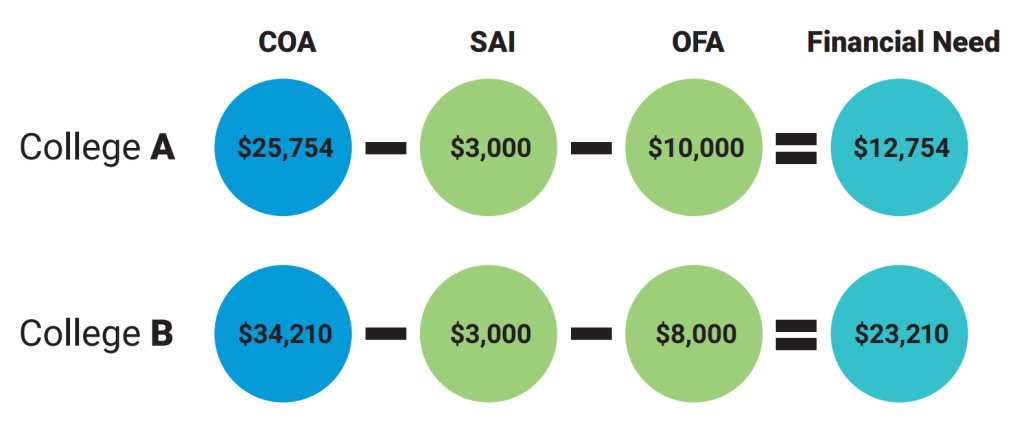
To determine how much aid you’re eligible for, colleges first calculate your financial need. Financial need is your Cost of Attendance (COA) minus your Student Aid Index (SAI) minus any Other Financial Aid (OFA). This shows the maximum amount you may receive in need-based aid. The financial aid office at each college then decides what types of aid to offer to meet your need.
Keep in mind that while your SAI stays the same at every college, COA—and sometimes OFA—can vary. As a result, your financial need will be different at each school.
COA
Cost of Attendance
This is an estimate of the typical costs students pay to attend a college. It usually includes tuition, fees, housing and meals (room and board), books and supplies, and transportation. Each college’s cost of attendance (COA) is different.
SAI
Student Aid Index
The FAFSA or Alternative Application calculates a number called the Student Aid Index (SAI), which is a number used to guide the determination of your financial need. It considers factors like your family’s income, assets, size, and living expenses. To get an estimate of your SAI, use the Federal Student Aid Estimator.
OFA
Other Financial Assistance
Other financial aid (OFA) includes all scholarships, grants, loans, or other assistance that is known to the college when it is calculating your financial need.
COA – SAI – OFA = Financial Need
What kind of financial aid will I get?

Grants & Scholarships
Grants and scholarships are considered gift aid and typically do not have to be paid back. When reviewing the grants and scholarships listed on the financial aid offer, read the details to see if they are renewable and if they have any conditions such as maintaining a certain GPA or staying in a specific major.
If you receive any private scholarships, you should report them—along with the amount and source—to your college’s financial aid office.

Student Loans
Make sure to borrow only what you need, since loans must be repaid. You can choose to decline loans or accept a smaller amount. You are responsible for paying interest on your loans while in college, unless it is listed as a subsidized loan on your financial aid offer.
If your financial aid offer includes a Parent PLUS Loan, your parent must apply for and repay that loan.

Work Study
By completing the FAFSA®, you are automatically considered for the Federal Work-Study program. Eligibility for Federal Work-Study is based on financial need. This program allows you to apply for part-time jobs on campus that are partially funded by federal financial aid. Like any other job, you are paid for the hours you work. However, your hours are usually limited (often up to 20 hours per week) until you earn the total amount listed in your financial aid offer for that term.
Making a Decision
Review your financial aid offers carefully
Review each offer carefully. If you’re a dependent student, go over the offers with your parents. Use comparison tools to help you understand your options and choose what works best for you. While cost shouldn’t be the only factor, it’s an important part of your final decision.
What happens if your situation changes?
If your family’s financial situation changes due to an unexpected loss of income or significant unexpected expenses, contact your financial aid office to see if your financial aid offer can be updated. You will likely need to provide additional documentation when requesting special consideration and will need to submit a letter of appeal.
For assistance with appealing your financial situation you can schedule a confidential one-on-one virtual meeting with an ISACorps member.
Accepting your financial aid
After you choose a college, follow the instructions in your financial aid letter to accept all or part of your financial aid package. Be sure to complete any additional steps required, such as entrance loan counseling, so your financial aid is properly applied to your account when you start classes.
Tips and Reminders
- Ask questions if you don’t understand everything in your financial aid offer.
- Ask your college’s financial aid office about payment plans and tuition payment procedures. The financial aid office is a great resource for finding information related to all types of financial aid, including information about your aid eligibility.
- Reach out to the college’s financial aid office if there are any unexpected changes in your family’s financial situation.
- Use ISAC’s financial aid offer comparison worksheet to compare financial aid offers from multiple schools.
- Create a budget and review any gift aid offered before accepting a student loan. You don’t have to take a student loan if it is offered to you, or you can borrow less than the full amount offered. Remember that any loans you accept will have to be paid back!